Five of Swords
Five of Swords
Pyrrhic victory, conflict, and broken trust
You won, but at what cost? The Five of Swords is a cruel triumph. It is the moment when the need to be right destroys the relationship itself.
Introduction
The Five of Swords speaks of a conflict where nobody truly wins. Its meaning is arguments, intrigue, backstabbing, and moments when ego overrides common sense.
This is the card of a Pyrrhic victory: you got what you wanted but lost respect, friends, or peace. Sometimes it is wiser to yield than to win the battle and lose the war.
Meaning
Upright Meaning
Consider whether the victory is worth the loss of trust — perhaps it’s time to change tactics.
Classical interpretation
Degradation, destruction, revocation, infamy, dishonour, loss, with the variants and analogues of these.
Source: A. E. Waite, The Pictorial Key to the Tarot. London: William Rider & Son, 1911. Part III, §2
Waite’s own wording, quoted in full from the public-domain text.
Love and relationships
Cruel arguments and a desire to hurt. Cheating or underhanded behavior. One partner dominates the other. A breakup.
Career and work
Office wars, sabotage, idea theft. A hostile team atmosphere. Unfair competition.
Money and finances
Fraud and loss due to deception. Unfair deals.
Spiritual path
Spiritual arrogance. Using knowledge to harm. Loss of moral compass.
Reversed Meaning
With the fight burned out, there’s room to apologize or accept an apology — walk away from a win that isn’t worth it and give the bitterness time to fade.
Classical interpretation
The same; burial and obsequies.
Source: A. E. Waite, The Pictorial Key to the Tarot. London: William Rider & Son, 1911. Part III, §2
Waite’s own wording, quoted in full from the public-domain text.
Reversed, the Five of Swords shows a conflict that has burned out. Everyone is tired of fighting. There is a chance for dialogue or a realization that the feud was pointless.
A step toward peace
Willingness to apologize or accept an apology. Trying to repair what can be saved.
Leaving the game
You see the win is not worth it and walk away. Refusing revenge.
Lingering bitterness
The conflict is over on the surface, yet the aftertaste remains. Time is needed to heal.
Symbolism
The classic scene
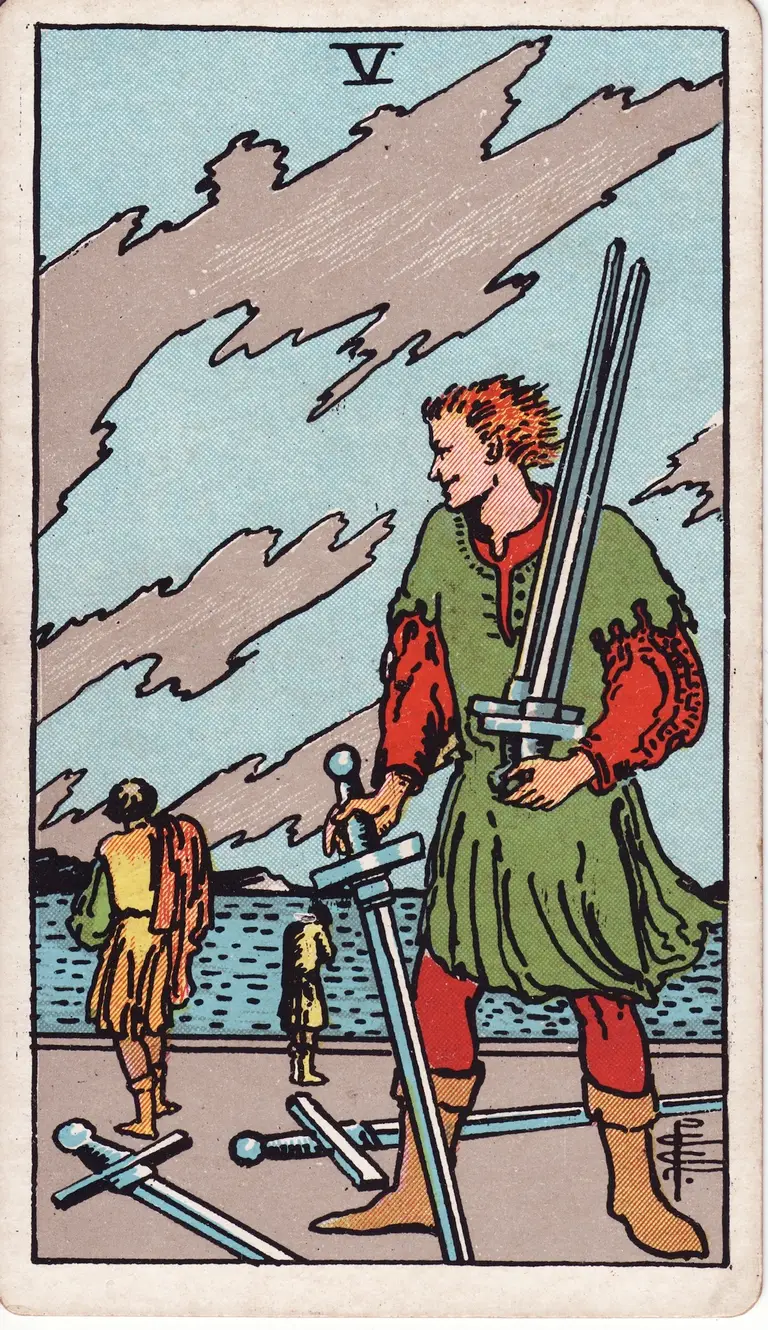
A smug man stands in the foreground holding three swords. Two more lie at his feet. In the distance, two figures walk away with heads lowered, defeated and humiliated. The sky is torn with gray clouds, signaling mental chaos and tension.
The victor stands alone. His posture shows triumph, but it is the triumph of isolation.
Find it in the picture
Our decks are stylized: the figure, objects and background may be drawn differently, but the card’s meaning stays the same.
Marseille Tarot
Five swords form a tangled structure with a disturbed center. This is mental dissonance and destructive thoughts that tear harmony apart.
Five of Swords in a Spread
Past
A harsh conflict or betrayal left a scar. You still expect a hidden blow.
Advice
Do not step into the fight. Yield to protect yourself. If you are wrong, admit it. Do not chase a win at any cost.
Outcome or direction
A conflict is likely, and it will be unpleasant. You risk losing friends or reputation. Consider whether it is worth the price.
Notable Combinations


Deep Dive
Mythology
Achilles after killing Hector. The loneliness of the winner. Loki sowing discord.
Astrology
In the Golden Dawn system this card is Venus in Aquarius — the first decan of Aquarius (0°–10°). Venus, the planet of harmony, cools in this detached air sign ruled by Saturn: feeling gives way to being right, and winning an argument can cost the relationship. The Golden Dawn calls the card the Lord of Defeat.
Kabbalah
Geburah (Severity) in the world of Yetzirah. Destructive force of intellect. A mind without love turns cruel.
Alchemy
Putrefactio. The rot of old ties and ego structures. Unpleasant but inevitable.
Meditation
Imagine a field after a battle. Smoke, broken weapons, silence. You stand amid the chaos with the victor’s sword in your hands. Look at those walking away. Do you feel joy, or only emptiness?
Ask yourself:
- Why do I need to be right?
- Whom did I hurt trying to prove my superiority?
- Am I ready to lay down the weapon first?
Conclusion
The Five of Swords is a hard lesson. Real strength is not humiliation but knowing when to stop. Release the ego and find peace.
I choose peace over being right. I release conflict and forgive myself and others.